
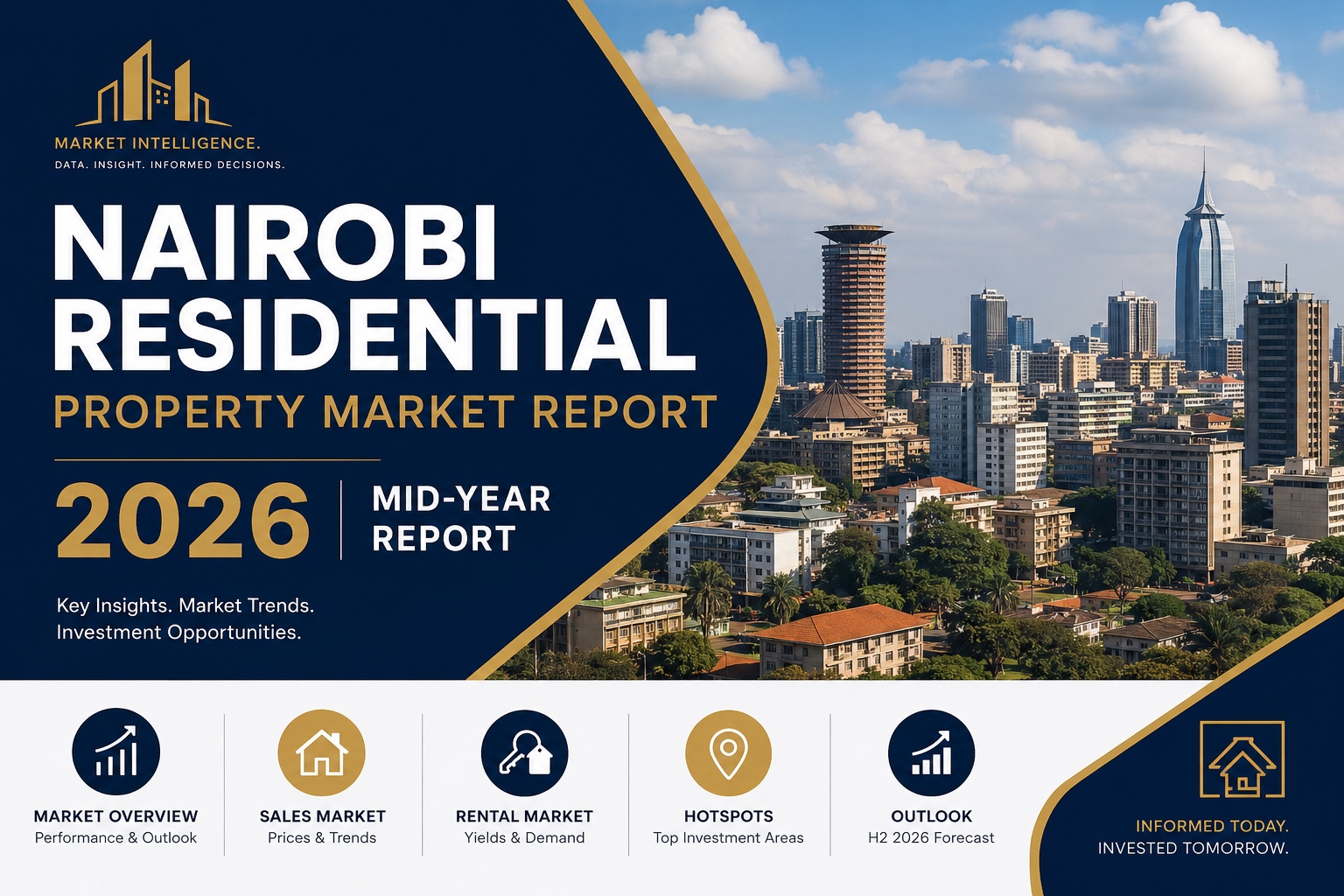
Nairobi Residential Property Market Report 2026
Mid-Year Market Intelligence Report
Executive Summary
The first half of 2026 has seen Nairobi’s residential property market transition into a more balanced and mature investment environment. While demand for quality housing remains resilient, market performance varies considerably across locations and property types.
Standalone houses in established suburbs continue to demonstrate steady capital appreciation, driven by limited supply and sustained owner-occupier demand. Conversely, apartment markets in several traditionally popular investment nodes are undergoing a correction due to increased stock levels and heightened competition among developers.
At the same time, improving infrastructure, gradual easing of monetary conditions, and continued urbanization are supporting long-term confidence in Nairobi’s residential sector.
Market Overview
Nairobi remains East Africa’s leading commercial hub and continues to attract domestic and international property investors. Population growth, rural-to-urban migration, diaspora investment, and government-backed housing initiatives continue to underpin housing demand.
The market in 2026 is characterized by:
Stable pricing across most residential segments.
Increased negotiation power for buyers.
Continued demand for completed, high-quality developments.
Strong investor focus on rental income and long-term capital preservation.
Rather than speculative growth, buyers are increasingly prioritizing location, construction quality, accessibility, and realistic pricing.
Residential Sales Market
Standalone Houses
Prime residential suburbs continue to outperform many other market segments. Areas such as Karen, Lavington, Kilimani, Spring Valley, and Westlands have recorded modest but positive growth, supported by constrained supply and continued demand from upper-middle-income households.
Key drivers include:
Limited availability of development land.
Preference for larger family homes.
Increased diaspora investment.
Strong demand for secure gated communities.
Apartment Market
The apartment sector presents a mixed picture. While well-managed developments in strategic locations continue to attract buyers, certain high-density neighbourhoods are experiencing pricing pressure due to oversupply.
Markets such as Westlands, Upper Hill, and parts of Kileleshwa and Kilimani have become increasingly competitive, creating favourable conditions for end-users and long-term investors seeking value acquisitions.
However, developments offering superior management, modern amenities, and proximity to diplomatic or commercial hubs continue to maintain healthy occupancy levels.
Rental Market Performance
Nairobi’s rental sector remains supported by a growing professional workforce, expatriate demand, and increasing urbanization.
The strongest performing rental segments continue to be:
Upper-middle income apartments.
Family homes within gated communities.
Developments located near major business districts and transport corridors.
Gross residential rental yields across Nairobi generally remain attractive when compared to traditional investment products, although returns vary significantly by location and asset quality. Quality property management and strategic location remain key determinants of performance.
Emerging Investment Hotspots
Thika Road Corridor
Neighbourhoods along the Thika Superhighway continue to benefit from expanding infrastructure, educational institutions, and commercial developments, making the corridor attractive for both owner-occupiers and investors.
Satellite Towns
Although some satellite markets have experienced moderated price growth, towns such as Ruiru, Juja, Syokimau, and Kitengela continue to attract buyers seeking affordability and long-term appreciation potential.
Prime Low-Density Suburbs
Karen, Lavington, Runda, and Spring Valley continue to benefit from limited housing supply and sustained demand from affluent local and international buyers.
Key Factors Influencing the Market
Infrastructure Development
Ongoing improvements in road networks and public infrastructure continue to enhance accessibility and support property values across Nairobi and its satellite towns.
Interest Rates and Financing
Although commercial mortgage rates remain relatively elevated, the broader monetary environment has become more accommodative, with lower benchmark rates improving investor sentiment. Cash purchases and developer payment plans continue to account for a significant proportion of residential transactions.
Demographic Growth
Nairobi’s expanding population and increasing household formation continue to create sustained demand for quality housing across multiple market segments.
Opportunities for Buyers and Investors
Current market conditions present several notable opportunities:
Acquisition of quality apartments in oversupplied locations at more competitive prices.
Investment in standalone homes within established suburbs where supply remains constrained.
Long-term investment in emerging satellite towns benefiting from infrastructure expansion.
Development of affordable and mid-market housing products targeting Nairobi’s growing middle-income population.
Investors are increasingly focusing on income-generating properties with stable rental demand rather than purely speculative capital appreciation.
Market Outlook: Second Half of 2026
The Nairobi residential property market is expected to remain stable through the remainder of 2026.
Our outlook suggests:
✓ Moderate growth in prime residential house prices.
✓ Continued buyer advantage within selected apartment markets.
✓ Sustained demand for affordable and middle-income housing.
✓ Increased investor preference for completed developments with proven rental performance.
Overall, the market continues to offer attractive opportunities for informed buyers and long-term investors who prioritize quality assets, strategic locations, and realistic pricing.
Nairobi’s residential property sector remains one of the most resilient investment classes in Kenya. While the era of rapid speculative gains has moderated, the market is evolving into one driven by fundamentals, transparency, and sustainable long-term value.
For buyers, investors, lenders, and developers, understanding local market dynamics has never been more important. Professional market analysis and property valuation remain essential tools for making sound real estate decisions in an increasingly sophisticated marketplace.
Disclaimer: This report is intended for general market information purposes only and should not be construed as investment, legal, or financial advice. Market conditions may vary by location and individual property characteristics.

Last updated:
