

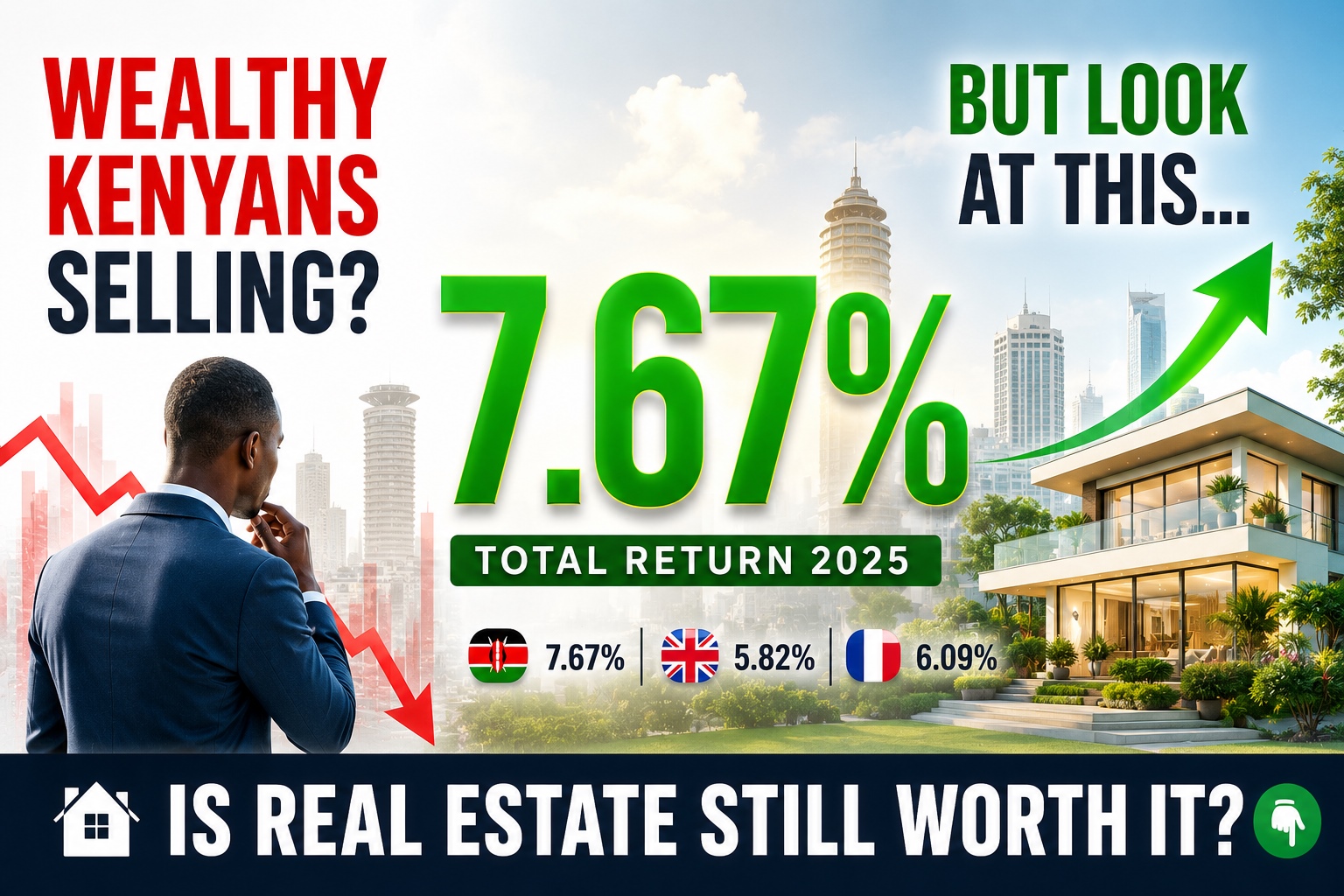
Is Real Estate Still a Good Investment in Kenya in 2026? A Comprehensive, Data-Driven Analysis
The question of whether real estate remains a viable investment in Kenya is more pertinent now than ever. For decades, land and property have been the bedrock of wealth creation for many Kenyans, offering a tangible hedge against inflation and a path to generational prosperity. However, the market in 2026 looks fundamentally different from the “buy land and wait” era of the past decade. This article provides a thorough, data-driven analysis for the discerning investor, breaking down the current market realities, emerging opportunities, and hidden risks.
Part One: The Current State of Kenya’s Real Estate Market in 2026
To answer the central question, we must first examine the macro-economic environment. Kenya’s real estate sector is undergoing a significant structural transformation. Data from Nairobi City County, published by the Kenya National Bureau of Statistics (KNBS), reveals that the total value of building plans approved in the capital increased by 3.1 percent to Sh62.44 billion in the first quarter of 2026—the highest figure since early 2023 .
However, this top-line growth masks a crucial shift. The value of approved commercial building plans rose 44.4 percent to Sh21.37 billion, while residential approvals fell 10.3 percent to Sh41.06 billion . Commercial projects now account for 34.2 percent of the total value of approvals, up from 24.4 percent a year earlier . This signals that private developers are increasingly redirecting investment towards offices, warehouses, and retail centres as the government aggressively expands its footprint in the residential market through the Affordable Housing Programme .
| Key Market Indicators (2025/2026) | Figure |
|---|---|
| Total Building Plan Approvals (Q1 2026) | Sh62.44 billion |
| Commercial Approvals Growth (YoY) | +44.4% |
| Residential Approvals Change (YoY) | -10.3% |
| Government Housing Expenditure (FY2025) | Sh79.03 billion |
| Nairobi Suburban Rental Yield | 7.4% (highest since 2007) |
| Premium Suburb House Price Growth (Q1 2026) | 1.1% |
Source: KNBS, HassConsult, Business Daily
Part Two: Key Investment Segments in 2026
1. Commercial Real Estate
The commercial sector has emerged as the new frontier. The “flight to quality” trend continues, with companies abandoning ageing Grade B offices for modern Grade A developments with better amenities and lower operating costs. Prime office occupancy in Nairobi has risen significantly, with rental yields for prime assets remaining stable .
Industrial and logistics real estate is quietly proving to be one of the most stable and scalable sectors. As Kenya strengthens its position as a regional trade hub, demand for warehousing—especially along Mombasa Road and the Eastern Bypass—continues to rise. Grade A warehouses serving e-commerce and FMCG players are delivering 8% to 12% yields, supported by long-term leases and relatively low maintenance costs .
2. Mixed-Use Developments and Integrated Communities
Master-planned communities are delivering some of the strongest returns. Tatu City, for instance, reports that land has appreciated by approximately 16 percent per annum, while completed homes are seeing about 18 percent capital appreciation. Rental yields for unfurnished units are up to nine percent, while furnished homes are achieving between 12 and 16 percent .
The trend is supported by strong capital inflows into integrated developments, which attracted about Sh65 billion in 2025, even as approvals for conventional residential projects declined .
3. The Prime Residential Market
Data from HassConsult shows Nairobi suburban home prices rose 1.1% in the first quarter of 2026, while rents climbed 1.3%, reinforcing the resilience of prime low-density housing . Detached homes in affluent suburbs such as Lavington, Spring Valley, and Karen are outperforming on sustained demand and limited supply, with suburban rental yields holding at 7.4%—comfortably above returns on short-term government securities .
Lavington recorded the highest house price growth at 4.2 percent in Q1 2026, followed by Spring Valley at 3.8 percent . Knight Frank notes that the prime residential market demonstrated stable growth during the first half of 2025, with the sales price index increasing by 5.63% year-over-year . Rental markets also showed consistency, with prime residential rents growing by 7.96 percent year-on-year .
Knight Frank’s Wealth Report indicates that 66 percent of high-net-worth individuals prefer Kenya as a home ownership destination—sustaining demand even amid economic uncertainty . Wealthy buyers and expatriates continue to drive demand for high-end properties, prompting developers to tilt portfolios toward upscale residential projects .
4. Apartments: A Segmented Market with Cautions
The apartment market is highly segmented, and caution is warranted in certain areas. In Kilimani, aggressive densification has led to a luxury apartment oversupply crisis. Gross rental yields for standard, non-serviced apartments have compressed to a range of 4% to 6%, with vacancy rates of 30-40% no longer uncommon .
By contrast, apartment prices in Muthangari and Riverside recorded gains in Q1 2026 . The divergence reflects growing concerns about saturation in Nairobi’s mid-market residential segment, while undersupply in certain prime areas supports price growth .
5. Satellite Towns: Migration and Rental Strength
Satellite towns continue to show resilience, driven by migration from Nairobi’s core. In the fourth quarter of 2025, stronger demand drove sales prices up by 4.5% and rents by 8.7% across satellite towns, raising yields to 5.2%—their highest since 2019 . The strongest rental growth was recorded in Ruiru and Kiambu, where annual rent increases reached 15.6% and 14.4% respectively .
However, in Q1 2026, satellite town sale prices fell 0.9% even as rents rose 1.4%, suggesting households squeezed by rising living costs are increasingly abandoning home ownership plans in favour of rental accommodation .
6. The Coastal Market: A Distinct Asset Class
Kenya’s coastal land market has emerged as a distinct investment segment, delinked from wider national economic trends. A Hass Consult Coastal Land Price Index covering 12 coastal towns found that land prices in affluent areas like Diani and Watamu skyrocketed by 70 percent since 2020 .
| Coastal Location | Price per Acre (2025) | 5-Year Growth |
|---|---|---|
| Nyali | Sh113.98 million | 24% |
| Diani | Sh35.98 million | 79.1% |
| Watamu | Sh34.97 million | 70% |
| Mombasa City | Sh91.3 million | 38% |
| Lamu | Sh81.6 million | 59.7% |
Source: Hass Consult Coastal Land Price Index
The index notes that areas with the widest beaches and most natural beauty command premium prices, with a “beauty premium” driving demand in Diani and Watamu . The market is driven by remote working, retirement relocation, and international buyers who first discovered the Coast as tourists—creating a distinct lifestyle asset class with substantial external capital flows .
7. Student Housing: The Underrated Goldmine
Purpose-built student accommodation is emerging as one of the most reliable high-yield investments. With the expansion of universities along Thika Road and Waiyaki Way, demand for secure, well-managed housing continues to outpace supply . A well-designed 10-room student property can generate between Sh960,000 and Sh2.1 million annually, translating to yields of 12% to 15% .
Acorn Investment Management Limited (AIML), owner of the student housing brand Qwetu, reported a 32 percent rise in half-year profits to Sh457 million, indicating growing investor interest in the segment . KCA University broke ground on its Sh7 billion masterplan in 2025, and the University of Nairobi is advancing a 4,000-bed Purpose-Built Student Accommodation project under a PPP model .
8. Informal Settlement Upgrading: The 1,200% Opportunity
One of the most remarkable stories in 2026 is the formalization of informal settlements. The government’s Sh27.8 billion Kenya Informal Settlements Improvement Project Phase Two (KISIP 2), jointly funded by the Government and development partners, is transforming land values .
In the Fort Jesus informal settlement scheme in Kiambu County, the price of a 50×100 plot has risen from Sh1 million in 2016 to Sh13 million in 2026—an increase of nearly 1,200 percent . Land values in 38 selected informal settlement schemes across Embu, Kirinyaga, Nyeri, and Kiambu counties have increased by between 87 percent and 1,200 percent over the last 16 years .
These dramatic price increases are attributed to improved infrastructure (water, sewerage, drainage, street lighting) and enhanced land tenure security through title deed issuance .
Part Three: Alternative Vehicles—REITs in 2026
For investors seeking liquidity and lower entry thresholds, Kenyan REITs offer a compelling alternative to physical property ownership. The listing of Africa Property Logistics (ALP) REIT on the Nairobi Securities Exchange—the first industrial and USD-denominated REIT on Kenya’s bourse—marks a milestone for the sector .
Through platforms like Vuka, entry points for some REITs are as low as KES 5,000, effectively democratising access to high-value real estate . REITs enjoy significant tax shields, including exemption from capital gains tax (CGT) and a reduced 5% withholding tax on dividends . A 10% total annual return on a REIT portfolio over a decade significantly outperforms the stagnant 2-4% rental growth and modest capital appreciation seen in saturated apartment segments .
However, the REITs market still faces challenges including high capital requirements for trustees, prolonged approval processes, and limited investor awareness .
Part Four: The Affordable Housing Programme—Government’s Growing Footprint
The government’s Affordable Housing Programme has become one of the fastest-growing areas of public expenditure since the introduction of the housing levy in July 2023. Actual spending on housing nearly tripled to Sh79.03 billion in the financial year ended June 2025 from Sh25.49 billion a year earlier—almost nine times higher than the Sh9.13 billion spent in 2022/23 .
Absorption of housing funds improved significantly, reaching 96.3 percent of the allocation in FY2025, compared with 32.6 percent in the previous year . The government has intensified implementation of the programme to address the country’s housing deficit while creating jobs and stimulating economic activity .
The aggressive public-sector push into housing coincides with growing caution among private residential developers facing elevated construction costs, expensive financing, and concerns over household purchasing power. While residential projects still account for the largest share of Nairobi’s construction pipeline, the fastest growth is now coming from commercial developments .
Part Five: The Risks—What’s Holding the Market Back
1. Election Year Caution
Political uncertainty ahead of the 2027 elections is prompting developers to delay new projects. According to Knight Frank, new developments are slowing across speculative commercial and high-risk residential segments as borrowing costs remain elevated and investors adopt a wait-and-see stance . Developers are prioritizing cash preservation and focusing on completing ongoing projects rather than launching new builds .
“2026 will be a year for disciplined execution and strategic positioning,” says Mark Dunford, CEO of Knight Frank Kenya. “The markets rewarding quality, sustainability, and clear demand fundamentals will thrive, while those chasing speculative growth will pause.”
2. Liquidity and Friction Costs
Real estate remains inherently illiquid. In Kilimani’s current environment, liquidating a physical asset can take six to eighteen months to find a buyer and complete the legal transfer . Beyond the yield compression, physical ownership involves substantial friction costs often overlooked in marketing brochures: 4% stamp duty, 1-1.5% legal fees, annual maintenance, service charges, and 10% rental income tax .
3. Oversupply in Certain Segments
The luxury apartment oversupply in Kilimani, with vacancy rates of 30-40%, continues to pressure yields . Apartment prices in Westlands and Upper Hill recorded declines in Q1 2026 as new supply weighed on absorption rates .
Part Six: The Strategic Path Forward—Advice for Different Investors
The End of Speculation, The Rise of Yield
The most significant trend emerging across the sector is the shift from speculation to performance. The 2026 investor is no longer asking “How much will this land be worth in 10 years?” but rather “What is this asset earning me today?”
Peter Kibugi, a real estate expert, observes: “For decades, real estate in Kenya followed a simple philosophy: buy land and wait. That strategy worked, for a time. In 2026, however, the market has fundamentally changed. Today’s investor is no longer patient in the traditional sense. They are intentional, analytical, and, most importantly, yield-focused.”
With mortgage rates ranging between 12% and 15%, any asset yielding below that becomes a liability. Investors can no longer afford to “hold and hope.” The numbers must work from the outset .
For First-Time Buyers
-
Consider emerging hotspots: Areas like Juja and Ngong are benefiting from migration patterns, with rental demand strengthening despite weaker transaction volumes .
-
Look at affordable housing units: The government’s Affordable Housing Programme offers units at various price points with 10% down payment .
-
Conduct rigorous due diligence: The formalization of informal settlements has created opportunities, but land title clarity remains essential .
-
Explore REITs for lower entry points: As low as KES 5,000 through platforms like Vuka .
For Income-Focused Investors
-
Student housing: Yields of 12% to 15% .
-
Industrial and logistics real estate: Grade A warehouses delivering 8% to 12% yields .
-
Short-stay properties: Well-managed serviced apartments in locations like Westlands achieving yields of 10% to 15% .
-
Commercial properties: Offices, warehouses, and retail centres showing the strongest growth in approvals .
For High-Net-Worth Investors
-
Prime detached homes: Lavington and Spring Valley led house price growth in Q1 2026 .
-
Master-planned communities: Tatu City delivering 16% annual land appreciation and 12-16% rental yields on furnished homes .
-
Coastal lifestyle assets: Diani and Watamu, where land prices have surged 70% since 2020 .
-
Consider REITs for diversification: Tax-shielded, liquid exposure to Grade A assets .
For Institutional Investors
-
Special Economic Zones (SEZs): Dongo Kundu SEZ at the Coast has recorded progress with lease agreements, attracting investors in logistics, manufacturing, and trade .
-
Government-backed PPPs: Affordable housing and infrastructure projects offering policy-aligned investments .
Conclusion: A Market in Transformation, Not Decline
Is real estate still a good investment in Kenya in 2026? The data unequivocally says yes—but only for the informed, patient, and yield-focused investor.
The era of “buy any piece of land and double your money in two years” is definitively over. The market has segmented significantly. Luxury apartments in Kilimani, detached units in premium suburbs, commercial office space, land in satellite towns, and coastal lifestyle assets each offer different risk-return profiles .
The structural drivers of demand remain robust: rapid urbanization, a housing deficit of over two million units, a growing middle class, and Kenya’s position as a regional business hub . Infrastructure investment—including the Talanta Sports City Stadium, Dongo Kundu SEZ, and ongoing affordable housing projects—continues to create new value corridors .
However, the rules of the game have changed. The smart money is no longer scattered; it is being deployed with precision into high-performing segments that deliver immediate cash flow . For the discerning investor willing to do the math, understand the tax implications, and invest for the long haul (10+ years), Kenyan real estate remains one of the most powerful wealth-building tools available.
It is no longer a game for the lucky—but a science for the strategic.
Quick Reference Summary
| Investor Type | Recommended Strategy |
|---|---|
| First-Time Buyer | Affordable housing units; satellite towns (Juja, Ngong, Kiambu); conduct due diligence; consider REITs for lower entry |
| Income-Focused Investor | Student housing (12-15% yields); industrial/logistics (8-12%); short-stay properties (10-15%); commercial buildings |
| High-Net-Worth | Prime detached homes (Lavington, Spring Valley); master-planned communities (Tatu City 16-18% appreciation); coastal lifestyle assets (Diani, Watamu) |
| Institutional Investor | SEZs (Dongo Kundu); PPP projects; Grade A commercial; affordable housing initiatives |
| Liquidity-Seeking | REITs (tax-shielded, as low as KES 5,000 entry) |
This analysis is for informational purposes only and does not constitute financial advice. Investors should conduct their own research and consult with licensed professionals before making investment decisions. All data cited is from publicly available reports and reflects the market as of mid-2026.

- Real Estate Investment : Best Opportunities in Kenya (2026–2027): Top Locations, ROI, and Strategies October 11, 2026
- Home Appraisal in Kenya: The Role of an Appraiser October 11, 2026
- Real Estate Transactions Kenya: Complete Buyer & Seller Guide October 11, 2026
- Estate Agents Registration Board (EARB) Kenya: Registration, Roles, and Legal Requirements October 11, 2026
- Land Board Consent in Kenya: Key Rules and Process October 11, 2026
Fact Checked & Editorial Guidelines
Our Fact Checking Process
We prioritize accuracy and integrity in our content. Here's how we maintain high standards:
- Expert Review: All articles are reviewed by subject matter experts.
- Source Validation: Information is backed by credible, up-to-date sources.
- Transparency: We clearly cite references and disclose potential conflicts.
Your trust is important. Learn more about our Fact Checking process and editorial policy.
Reviewed by: Subject Matter Experts
Our Review Board
Our content is carefully reviewed by experienced professionals to ensure accuracy and relevance.
- Qualified Experts: Each article is assessed by specialists with field-specific knowledge.
- Up-to-date Insights: We incorporate the latest research, trends, and standards.
- Commitment to Quality: Reviewers ensure clarity, correctness, and completeness.
Look for the expert-reviewed label to read content you can trust.
