

Market Value vs. Forced Sale Value: Key Differences Explained by Kenya Avenue Valuers Ltd
Market value and forced sale value are two distinct property valuation concepts that every homeowner, investor, and real estate professional in Kenya must understand. Whether you’re buying, selling, or securing financing, knowing this difference can save you thousands of shillings and prevent costly misunderstandings. Kenya Avenue Valuers Ltd, a leading valuation firm in Nairobi, specializes in helping clients navigate these nuanced distinctions. In this article, we break down the definitions, applications, and implications of market value and forced sale value, with insights from Kenya Avenue Valuers Ltd.
What Is Market Value?
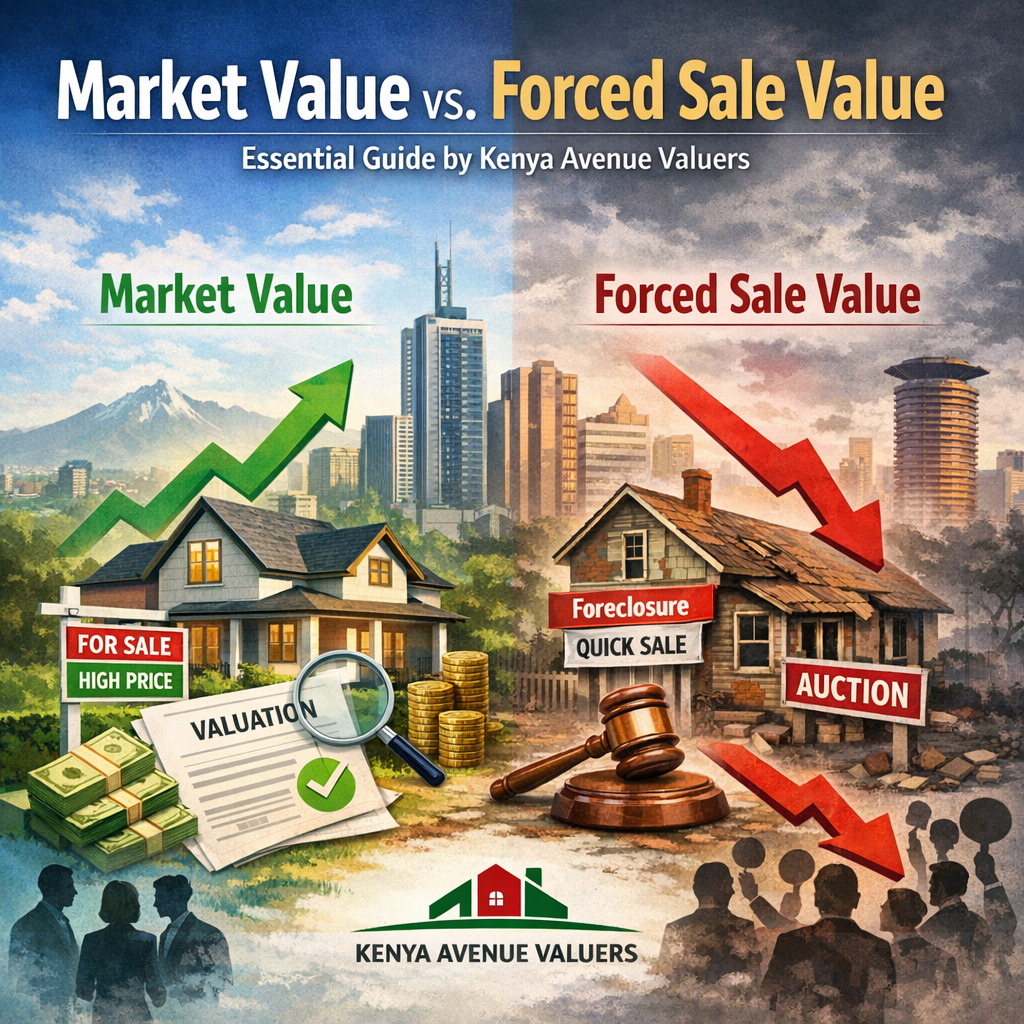
Market value is the most commonly used valuation concept in real estate. It refers to the estimated price at which a property would sell in an open, competitive market, assuming both buyer and seller are well-informed and acting without undue pressure. This valuation assumes a reasonable time frame for exposure to the market—typically 6 to 12 months for residential properties in Kenya.
Key characteristics of market value include:
- Arm’s length transaction: Both parties are independent and not related.
- Full exposure: The property is marketed to a wide pool of potential buyers.
- No urgency: The seller is not forced to sell, and the buyer is not forced to buy.
- Typical financing: The sale assumes conventional mortgage or cash payment.
For example, if a three-bedroom house in Lavington, Nairobi, is listed for Ksh 15 million, and similar properties have sold for Ksh 13–14.5 million in recent months, the market value would be approximately Ksh 14 million—reflecting current demand, location, and property condition.
What Is Forced Sale Value?
Forced sale value—also known as “liquidation value” or “distressed sale value”—is the estimated price a property would fetch under urgent or compulsory sale conditions. This valuation typically applies when the seller must dispose of the asset quickly, such as in a bankruptcy, foreclosure, divorce, or bank repossession.
Unlike market value, forced sale value assumes:
- Short marketing period: Often 30–90 days or less.
- Limited buyer pool: Only buyers able to act quickly, often cash buyers.
- Seller distress: The seller is under pressure to sell, which reduces bargaining power.
- Potential discounts: Buyers expect a discount for taking on risk, such as property condition or legal encumbrances.
In Kenya, forced sale values typically range from 10% to 30% below market value, though the discount can be steeper for unique properties or those in poor condition. For example, a commercial building valued at Ksh 50 million on the open market might only achieve Ksh 35–40 million in a forced sale scenario.
Key Differences Between Market Value and Forced Sale Value
| Aspect | Market Value | Forced Sale Value |
|---|---|---|
| Definition | Price under normal, open market conditions | Price under urgent, compulsory conditions |
| Timeframe | Reasonable (months) | Short (weeks to months) |
| Buyer pool | Wide, typical buyers | Narrow, often cash buyers |
| Seller motivation | Not urgent | Urgent/distressed |
| Typical discount | None (fair price) | 10%–30% reduction |
| Applies to | General sale, valuation for loans | Foreclosures, bankruptcies, court orders |
| Risk to buyer | Lower | Higher (due to limited due diligence) |
How Kenya Avenue Valuers Ltd Recommends Using Both Values
Kenya Avenue Valuers Ltd advises that property owners and investors understand when each value is relevant.
Market value is essential for:
- Securing mortgage financing (banks use market value for loan-to-value ratios).
- Selling a property under normal circumstances.
- Insurance purposes (replacement cost).
- Estate planning or divorce settlements.
Forced sale value is critical for:
- Assessing collateral risk for lenders.
- Quick sales due to financial distress.
- Court-ordered valuations (e.g., in bankruptcy cases).
- Buying distressed assets at auction.
For example, a bank lending against a property will use market value to determine the loan amount, but they also estimate forced sale value to gauge potential loss if the borrower defaults. Kenya Avenue Valuers Ltd often provides both valuations in their reports to give clients a complete picture.
Why the Difference Matters in Kenya’s Real Estate Market
Kenya’s property market is dynamic, with varying liquidity across segments. In prime areas like Westlands or Karen, market value tends to hold well because demand is high. However, in less liquid markets—such as rural towns or specialized commercial zones—forced sale discounts can be larger because finding a cash buyer quickly is harder.
For sellers, understanding forced sale value is crucial if you must sell fast. For buyers, knowing the forced sale value can help you negotiate better deals, especially at auctions or when dealing with distressed sellers. But remember: a property purchased at forced sale value may come with hidden costs—such as legal fees, repairs, or title issues—that reduce the apparent discount.
Practical Example: A Case Study from Kenya Avenue Valuers Ltd
Consider a 4-bedroom townhouse in Ruaka, Nairobi. Under normal market conditions, Kenya Avenue Valuers Ltd assesses its market value at Ksh 18 million. However, the owner faces a divorce and needs cash within 60 days. The forced sale value is estimated at Ksh 14 million—a 22% discount.
A cash buyer acquires the property at Ksh 14.5 million, benefiting from the seller’s urgency. The buyer also spends Ksh 1 million on renovations, bringing total investment to Ksh 15.5 million. After the market stabilizes, the property’s market value recovers to Ksh 18 million, giving the buyer a profit of Ksh 2.5 million—but this requires patience and risk tolerance.
Key Takeaways for Property Owners and Investors
- Don’t confuse the two: Market value is for normal sales; forced sale value is for emergencies. Using the wrong valuation can lead to unrealistic expectations or financial loss.
- Get a professional valuation: Kenya Avenue Valuers Ltd provides accurate, context-specific valuations. Always request both values if you’re buying or selling under pressure.
- Factor in costs: Forced sale prices may seem attractive, but factor in legal fees, survey costs, and potential property issues.
- Know your timeline: If you can wait, aim for market value. If you need liquidity fast, accept a forced sale discount.
Final Thoughts
The difference between market value and forced sale value is not just academic—it directly affects your financial decisions in Kenya’s real estate market. Whether you’re a first-time buyer, a developer, or a bank, knowing when and why each valuation applies can protect your investment. Kenya Avenue Valuers Ltd stands ready to guide you with expert advice and accurate appraisals tailored to your needs.
For a personalized valuation or consultation, contact Kenya Avenue Valuers Ltd today.

Last updated:
