
 by
by 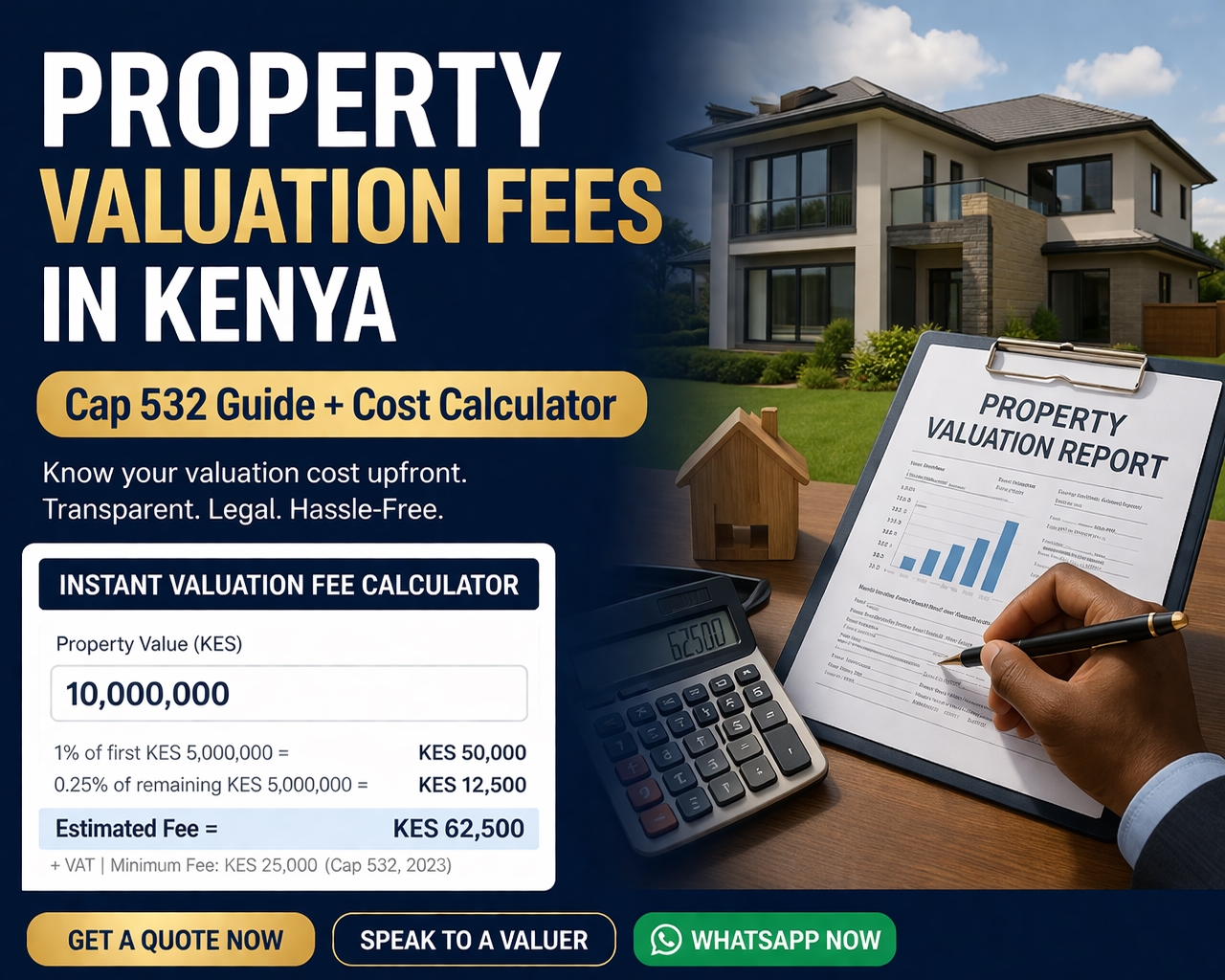
How Valuation Fees Is Calculated in Kenya (Valuers Act Cap 532)
One of the most common questions property owners ask is:
“How much does valuation cost in Kenya?”
The answer lies in law. Valuation fees is regulated under the Valuers Act Cap 532, specifically the Valuers (Forms & Fees) Rules, reviewed and updated in 2023.
This means valuation fees is structured, predictable, and based on a clear formula — not guesswork.
How Valuation Fees Is Determined in Kenya
In Kenya, valuation fees is calculated using a graduated scale based on property value.
Key Principles
- Fees is based on the market value of the property
- A tiered percentage system is applied
- There is a minimum fee of KES 25,000
- Additional costs may apply depending on the assignment
1. Standard Property Valuation Formula
For most property valuations (land and buildings), the legal fee structure is:
- 1% of the first KES 5,000,000
- 0.25% of the remaining value
Example 1: Property Worth KES 10 Million
- 1% of first 5,000,000 = 50,000
- 0.25% of next 5,000,000 = 12,500
✅ Total valuation fee = KES 62,500 (+ VAT)
Example 2: Property Worth KES 3 Million
- 1% of 3,000,000 = 30,000
✅ Total valuation fee = KES 30,000 (+ VAT)
(Above the minimum threshold)
Example 3: Property Worth KES 1 Million
- 1% = 10,000
❌ Below minimum
✅ Applicable fee = KES 25,000 (minimum fee)
2. Rental Valuation Fees (Income-Based Properties)
For rental or income valuation, fees is based on annual rental income:
- 10% of the first KES 800,000
- 5% of the remaining income
Example 4: Annual Rental Income KES 1.2 Million
- 10% of 800,000 = 80,000
- 5% of 400,000 = 20,000
✅ Total valuation fee = KES 100,000
3. Compulsory Acquisition Valuation
Used mainly in government-related land acquisition:
- 2% of first KES 5,000,000
- 0.5% of the balance
4. Plant, Machinery & Specialized Valuation
For industrial and specialized assets:
- 1.5% of first KES 10,000,000
- 0.5% of the remainder
5. The Minimum Fee Rule (Very Important)
Regardless of calculations:
👉 Minimum valuation fees is set at KES 25,000 by the law.
This applies to:
- Small plots
- Low-value houses
- Basic residential units
6. Additional Costs Clients Should Expect
Besides the main valuation fee, clients may incur:
- Transport and site inspection costs
- Official search fees
- Report preparation costs
- VAT (16%).
These are allowed under the Valuers Act Cap 532 as disbursements.
Why Valuation Fees Decreases as Property Value Increases
Kenya uses a graduated fee scale, meaning:
- Lower-value properties → higher percentage rate
- Higher-value properties → lower marginal rate
👉 This ensures fairness across all property classes.
Frequently Asked Questions (FAQs)
Is it legal to charge below the set valuation fees?
No. Charging below the prescribed scale may indicate non-compliance with the Valuers Act Cap 532.
Why do valuation quotes differ slightly?
Differences may come from:
- Location of the property
- Travel/logistics
- Complexity of the valuation
- Urgency
Do banks follow the same valuation fee structure?
Yes. Financial institutions rely on the same legal framework, although they may have pre-agreed valuers.
Can valuation fees be negotiated?
Partially — but:
- The legal structure still applies
- Discounts may only apply in large or repeat assignments
Valuation fees in Kenya is not arbitrary — it is legally defined, transparent, and standardized under the Valuers Act Cap 532 (updated 2023).
Understanding how valuation fees is calculated helps you:
- Budget accurately
- Avoid being overcharged
- Work with credible, compliant valuers
Key Takeaway
👉 Once you know your property value, you can estimate your valuation fee yourself using the legal formula.

Our Fact Checking Process
We prioritize accuracy and integrity in our content. Here's how we maintain high standards:
- Expert Review: All articles are reviewed by subject matter experts.
- Source Validation: Information is backed by credible, up-to-date sources.
- Transparency: We clearly cite references and disclose potential conflicts.
Your trust is important. Learn more about our Fact Checking process and editorial policy.
Our Review Board
Our content is carefully reviewed by experienced professionals to ensure accuracy and relevance.
- Qualified Experts: Each article is assessed by specialists with field-specific knowledge.
- Up-to-date Insights: We incorporate the latest research, trends, and standards.
- Commitment to Quality: Reviewers ensure clarity, correctness, and completeness.
Look for the expert-reviewed label to read content you can trust.


Join The Discussion