
 by
by 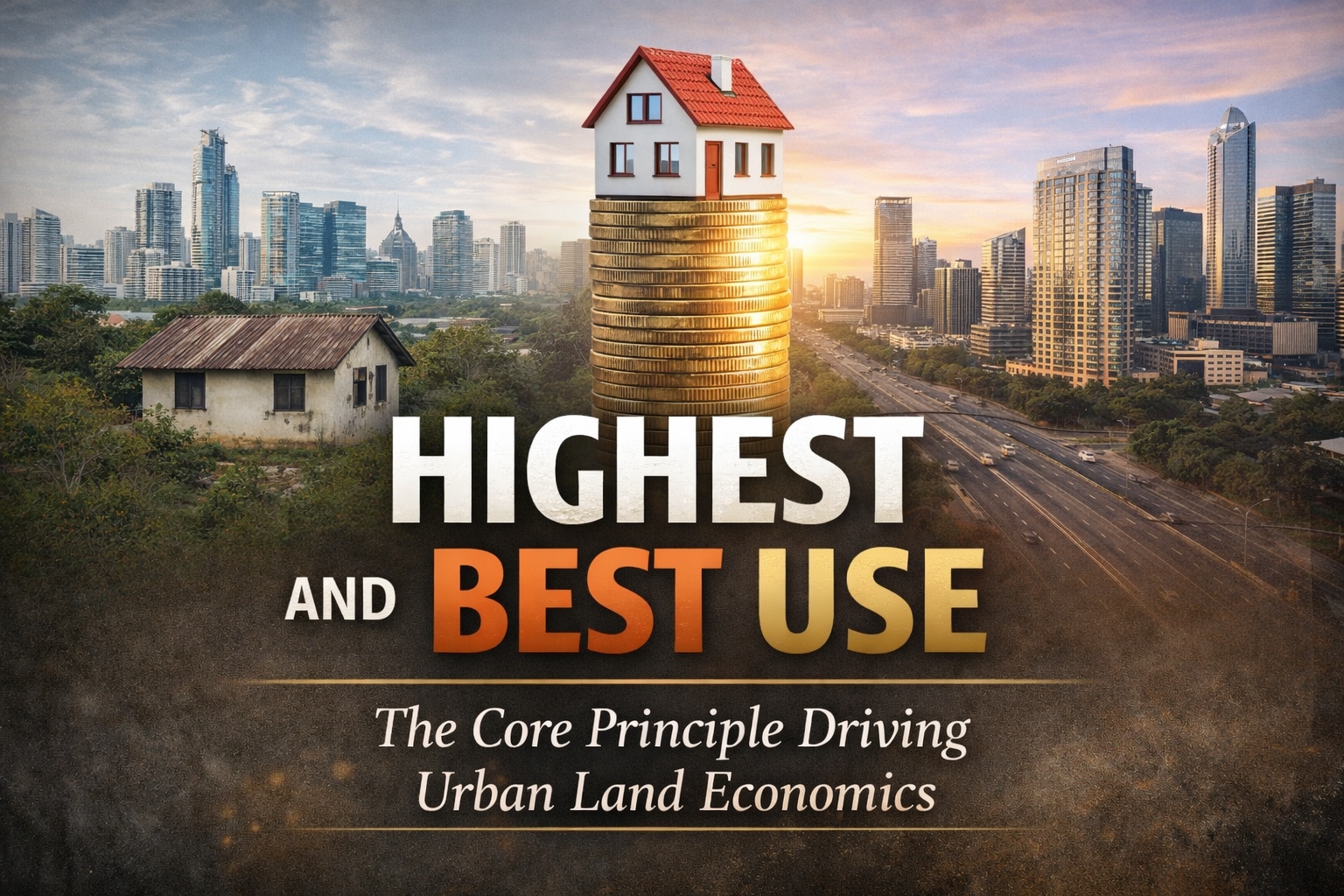
Highest and Best Use: The Core Principle Driving Urban Land Economics
Cities do not grow randomly.
They grow where value is allowed to concentrate.
Behind every skyline, every gentrifying neighbourhood, every disputed zoning change, and every dramatic land price increase lies a single, quiet but powerful principle—Highest and Best Use (HBU).
It is the invisible hand that guides urban form.
It determines whether land remains underdeveloped or transforms into dense mixed-use hubs.
It explains why modest structures sit on extraordinarily valuable land—and why demolition is sometimes the most rational economic decision.
In land economics, buildings are temporary.
Land use decisions are somewhat permanent.
Understanding Highest and Best Use is not just essential for valuers and developers—it is foundational to understanding how cities evolve, why land prices rise, and where future opportunity lies.
Understanding Highest and Best Use
At its core, Highest and Best Use is a valuation and planning concept that asks a deceptively simple question:
What is the most valuable, legally permissible, physically possible, and financially feasible use of a piece of land?
But behind this question lies a rigorous analytical framework that governs modern urban land economics.
HBU is not about what currently exists on land.
It is about what should exist, given market forces, policy frameworks, and economic logic.
This is why valuers often say:
“We value land as if vacant and available for its best use.”
The Four Tests of Highest and Best Use
For a use to qualify as the Highest and Best Use, it must pass four sequential tests. If it fails any one, it is disqualified.
1. Legal Permissibility
Land use must comply with:
-
Zoning regulations
-
Planning policies
-
Development controls
-
Environmental and heritage restrictions
A high-rise apartment may be financially attractive, but if zoning allows only single-dwelling residential use, it fails the first test—unless rezoning is probable and supportable.
Urban land economics is therefore deeply tied to policy decisions, not just market demand.
2. Physical Possibility
The land must be physically capable of supporting the proposed use.
This includes:
-
Plot size and shape
-
Topography and soil conditions
-
Access and frontage
-
Availability of infrastructure (roads, sewer, power, water)
A narrow, landlocked plot may not physically support large-scale development—even if zoning allows it.
Cities reward land that is usable, accessible, and serviceable.
3. Financial Feasibility
The proposed use must generate a positive economic return.
This involves:
-
Construction costs
-
Financing costs
-
Market demand and achievable rents or sale prices
-
Developer margins and risk
Many uses are legally and physically possible—but economically irrational.
Urban transformation only happens when numbers work.
4. Maximum Productivity
Among all feasible uses, the one that produces the highest land value becomes the Highest and Best Use.
This is the decisive step.
If offices, residential apartments, and mixed-use development are all feasible, the use that yields the highest residual land value wins.
This is where land economics becomes competitive.
Why Highest and Best Use Drives Urban Growth
Cities expand not because land exists—but because land value can be intensified.
From Low Use to High Use
Urban growth often follows a predictable sequence:
-
Agricultural or vacant land
-
Low-density residential
-
Medium-density housing
-
High-density or mixed-use development
Each stage represents a higher and better use driven by:
-
Infrastructure investment
-
Population growth
-
Economic activity
-
Policy shifts
When land remains stuck at a lower use while surrounding areas intensify, value pressure builds. Eventually, redevelopment becomes inevitable.
The Demolition Paradox
One of the clearest illustrations of HBU is demolition.
When a structurally sound building is demolished, it is rarely because the building has failed.
It is because the land has outgrown the building.
A single-storey bungalow on a major urban corridor may still be functional—but if zoning and demand support a multi-storey commercial block, the bungalow represents economic underutilization.
In land economics, this is called functional obsolescence driven by land value.
Highest and Best Use vs Current Use
A critical distinction in valuation and planning is the difference between:
-
Current Use
-
Highest and Best Use
Current use reflects the present reality.
HBU reflects economic potential.
This distinction explains why:
-
Land prices rise ahead of development
-
Speculation occurs in transitional zones
-
Infrastructure announcements reprice entire corridors
Markets are forward-looking. They price land based on what it can become, not what it is.
HBU and Urban Density
Density is not ideological—it is economic.
As land prices rise, cities respond by:
-
Building upward
-
Intensifying use
-
Mixing functions
High-density development is not imposed; it emerges when land scarcity makes low-density use inefficient.
This is why:
-
Central business districts evolve vertically
-
Transit corridors attract apartments and offices
-
Mixed-use developments outperform single-use zoning in prime locations
Density is the market’s answer to land scarcity.
Infrastructure as a Catalyst for Higher Use
Infrastructure does not just connect cities—it unlocks new Highest and Best Uses.
Roads, rail, utilities, and public services:
-
Expand legal and physical feasibility
-
Reduce development costs
-
Increase market demand
A plot that was once suitable only for low-density housing may suddenly support:
-
Retail centres
-
Logistics hubs
-
High-rise residential
This is why infrastructure-led land value uplift is one of the most powerful forces in urban economics.
Highest and Best Use in Emerging Cities
In emerging and rapidly urbanizing cities, HBU analysis becomes even more critical.
These markets often experience:
-
Rapid policy changes
-
Infrastructure catch-up
-
Informal land use patterns
Land that appears underdeveloped is often not misused—it is waiting for legal and infrastructural alignment.
Savvy investors and planners focus not on what exists, but on:
-
Where zoning is likely to change
-
Where infrastructure is planned
-
Where demand is forming
HBU thinking is inherently forward-looking.
The Role of Policy in Determining HBU
Governments shape land economics more than markets alone.
Through:
-
Zoning controls
-
Plot ratios
-
Building height limits
-
Land use designations
Policy can either:
-
Unlock land value
-
Suppress development
-
Redirect growth
Well-designed policy aligns market forces with public good. Poor policy creates artificial scarcity, speculation, and affordability crises.
In this sense, urban planning is applied land economics.
HBU and Housing Affordability
Housing affordability is often discussed as a construction problem. In reality, it is primarily a land use problem.
When land is locked into low-density or single-use zoning in high-demand areas:
-
Supply is constrained
-
Prices rise
-
Affordability declines
Allowing higher and better use:
-
Increases supply
-
Improves efficiency
-
Reduces per-unit land cost
The solution is not cheaper buildings—it is better land utilization.
Highest and Best Use from a Valuation Perspective
For professional valuers, HBU is not theoretical—it is operational.
Valuation relies on:
-
Market evidence
-
Comparable land sales
-
Residual land value analysis
Land is valued based on its optimal use, not existing improvements.
This is why:
-
Two identical plots with different zoning have different values
-
Corner plots often outperform interior plots
-
Frontage and access materially affect land value
HBU analysis transforms raw land into an economic asset.
Speculation vs Strategic Land Holding
Not all undeveloped land is speculative.
True land banking is informed by HBU logic:
-
Understanding future zoning
-
Anticipating infrastructure
-
Aligning with demographic trends
Speculation ignores feasibility.
Strategy respects the four tests.
Markets reward informed patience.
The Future of Highest and Best Use
As cities face new challenges—climate change, sustainability, remote work—HBU will continue to evolve.
Future considerations include:
-
Mixed-use resilience
-
Transit-oriented development
-
Environmental constraints
-
Adaptive reuse
The highest and best use of tomorrow’s land may prioritize:
-
Flexibility
-
Sustainability
-
Community integration
But the core principle remains unchanged:
Land must be used where it creates the most value—economically and socially.
Conclusion: Why Highest and Best Use Matters More Than Ever
Highest and Best Use is not just a valuation concept.
It is the engine of urban transformation.
It explains:
-
Why cities densify
-
Why land prices behave the way they do
-
Why redevelopment is inevitable
-
Why policy decisions shape wealth
Buildings rise and fall.
Markets fluctuate.
But land, when aligned with its highest and best use, becomes the most enduring asset in any urban economy.
Understanding this principle is not optional for anyone serious about real estate, planning, or investment.
It is the foundation upon which cities are built—and rebuilt.

Our Fact Checking Process
We prioritize accuracy and integrity in our content. Here's how we maintain high standards:
- Expert Review: All articles are reviewed by subject matter experts.
- Source Validation: Information is backed by credible, up-to-date sources.
- Transparency: We clearly cite references and disclose potential conflicts.
Your trust is important. Learn more about our Fact Checking process and editorial policy.
Our Review Board
Our content is carefully reviewed by experienced professionals to ensure accuracy and relevance.
- Qualified Experts: Each article is assessed by specialists with field-specific knowledge.
- Up-to-date Insights: We incorporate the latest research, trends, and standards.
- Commitment to Quality: Reviewers ensure clarity, correctness, and completeness.
Look for the expert-reviewed label to read content you can trust.


Join The Discussion