
 by
by 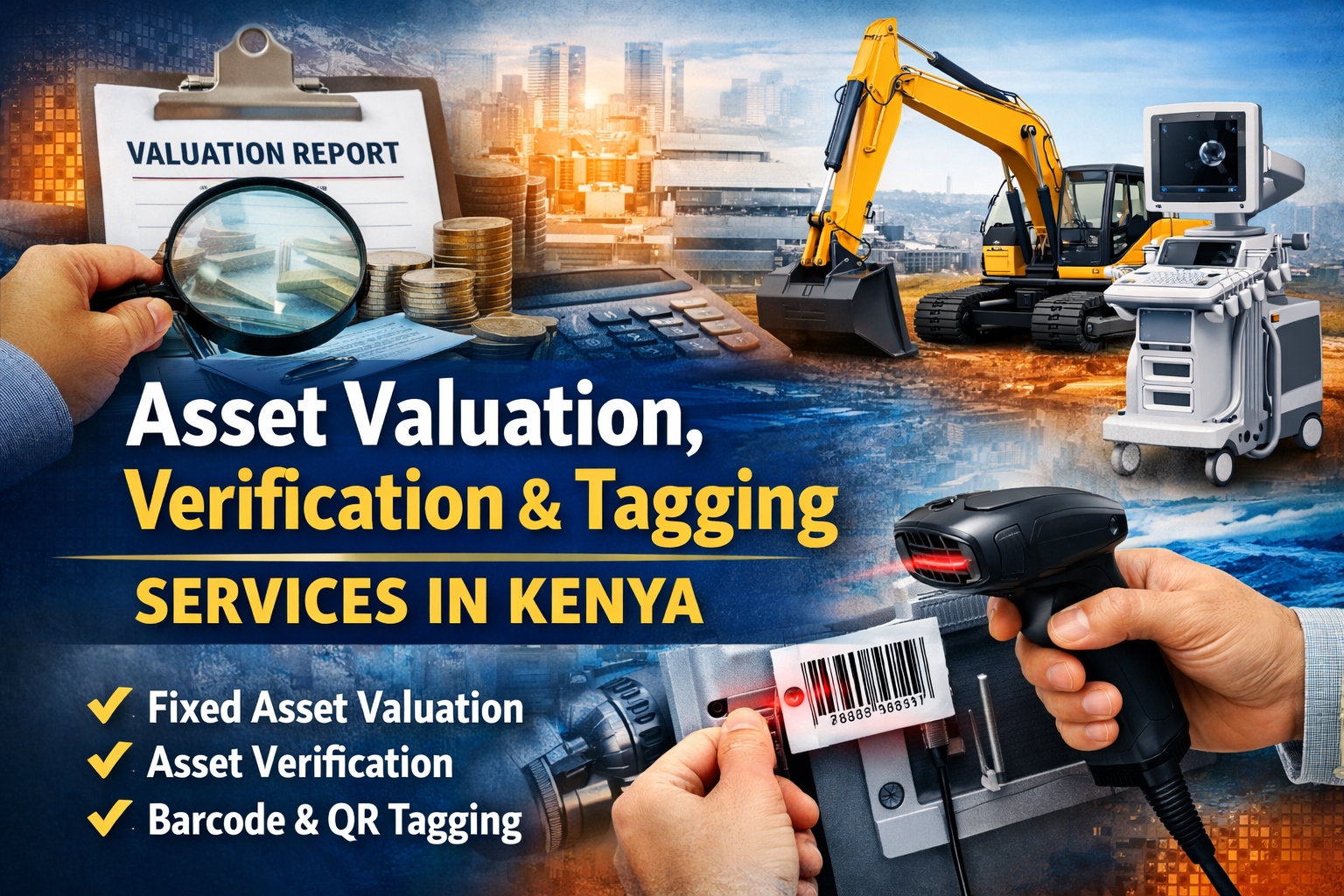
Asset Valuation, Asset Verification & Asset Tagging Services in Kenya: A Complete Guide for Businesses
In an increasingly regulated and audit-driven business environment, organizations in Kenya are placing greater emphasis on accurate asset records, proper valuation reporting, and stronger accountability systems. Whether you operate a manufacturing plant, hotel, school, NGO, SACCO, hospital, or a multi-branch corporate enterprise, the ability to track and manage fixed assets is no longer optional—it is a critical part of financial governance.
Fixed assets such as machinery, office equipment, furniture, ICT infrastructure, vehicles, and specialized tools represent significant capital investment. However, many organizations continue to struggle with outdated asset registers, missing equipment, unrecorded disposals, inaccurate depreciation schedules, and inconsistent asset values in financial statements. These gaps often create audit challenges, increase insurance exposure, and lead to poor decision-making at management level.
This is why professional asset valuation services in Kenya, supported by physical asset verification and structured asset tagging solutions, have become essential for organizations seeking transparency, compliance, and operational efficiency. A properly executed fixed asset exercise not only strengthens internal controls but also provides credible documentation for financial reporting, insurance purposes, due diligence, and regulatory audits.
This guide provides a detailed explanation of fixed asset valuation, asset verification services, and barcode/QR code asset tagging in Kenya, including how the process works, why it matters, and how businesses can benefit from an updated asset register and professional valuation reporting.
What is Asset Valuation?
Asset valuation is the professional assessment of the current monetary value of an organization’s assets. It involves determining the fair value or replacement value of fixed assets based on their type, age, condition, usage, remaining useful life, and prevailing market or replacement costs.
A professional fixed asset valuation typically covers:
-
Plant and machinery
-
Motor vehicles and fleet assets
-
Office furniture and fittings
-
Computers, printers, and ICT equipment
-
Tools and specialized equipment
-
Industrial production equipment
-
Hotel furniture, fittings and equipment (FF&E)
-
Medical equipment and institutional assets
A credible fixed asset valuation report is prepared using recognized valuation principles and provides an accurate basis for accounting treatment, depreciation, insurance scheduling, and asset management planning.
Why Asset Valuation is Important for Businesses in Kenya
For most organizations, fixed assets represent one of the largest components of the balance sheet. Unfortunately, these assets are often undervalued, overvalued, or poorly tracked. Conducting regular asset valuation ensures that asset values reflect economic reality and supports better financial governance.
1. Accurate Financial Reporting and IFRS Compliance
Companies preparing financial statements under IFRS require credible asset values that support proper reporting. Inaccurate values often result in:
-
Misstated balance sheets
-
Incorrect depreciation calculations
-
Inconsistent profit and loss reporting
-
Weak internal reporting for management decisions
A professional IFRS asset valuation in Kenya ensures that the organization’s fixed asset values align with financial reporting standards and audit expectations.
2. Audit Support and Statutory Compliance
External auditors frequently require updated asset schedules and evidence of physical asset existence. Without proper valuation and verification, organizations risk audit qualifications or unresolved audit queries.
A professional fixed asset valuation exercise provides audit-ready documentation, including asset registers, valuation schedules, and reconciliation reports.
3. Insurance Valuation and Risk Protection
Insurance valuation is a major driver of fixed asset revaluation. Many businesses remain under-insured due to reliance on outdated asset costs or historical purchase prices.
A professional insurance asset valuation report in Kenya helps ensure assets are insured at realistic replacement values, improving compensation outcomes in the event of fire, theft, flood, or accidental damage.
4. Corporate Restructuring, Mergers and Due Diligence
During acquisitions, restructuring, or investor onboarding, asset valuation becomes critical. Investors and financiers require credible asset data to assess business worth, operational strength, and risk exposure.
Accurate asset valuation also supports due diligence exercises by confirming what the company truly owns and its realistic current value.
5. Loan Security and Financing Documentation
Banks and lenders often request valuation schedules for equipment, vehicles, and machinery used as collateral. A professionally prepared asset valuation report strengthens financing applications and provides reliable documentation for credit evaluation.
Understanding Fixed Assets and Why They Require Proper Management
Fixed assets are long-term operational assets used in the production of goods or delivery of services. These assets are not intended for immediate resale but form the foundation of business operations.
Despite their importance, many organizations experience challenges such as:
-
Missing assets and unaccounted equipment
-
Duplicate procurement due to poor tracking
-
Assets transferred between branches without records
-
Obsolete equipment remaining in the register
-
Depreciation schedules that do not reflect reality
-
Weak internal controls leading to theft or misuse
To address these gaps, organizations implement structured fixed asset management supported by asset verification and asset tagging services.
What is Asset Verification?
Asset verification is the physical inspection process used to confirm the existence, location, and condition of assets recorded in an asset register. It is a critical control process that strengthens accountability and improves reliability of fixed asset data.
During an asset verification exercise, professionals assess:
-
Asset description accuracy
-
Serial numbers and model details
-
Location and departmental assignment
-
Operational condition and usability
-
Evidence of missing or unrecorded assets
-
Asset ownership and identification consistency
A well-executed verification exercise produces a reconciliation report showing discrepancies between recorded and physically observed assets.
Why Asset Verification is Critical for Organizations
1. Strengthens Asset Accountability
Asset verification ensures that every asset can be assigned to a responsible department, office, or user. This reduces internal disputes and strengthens asset governance.
2. Identifies Missing, Idle or Misallocated Assets
One of the most common findings during asset verification is the discovery of assets that are:
-
Missing
-
Damaged beyond repair
-
Idle or underutilized
-
Transferred without documentation
-
No longer in use but still recorded
This information is essential for management planning, budgeting, and disposal decisions.
3. Improves Audit Readiness
Organizations that conduct routine asset verification are significantly better prepared for annual audits. Verification ensures that asset registers are reliable and that supporting evidence exists for audit review.
4. Reduces Theft and Fraud Risk
Assets that are not tracked are vulnerable to loss and misappropriation. Verification exercises improve transparency and deter theft by ensuring assets are routinely accounted for.
What is Asset Tagging?
Asset tagging is the process of labeling assets using unique identification tags for tracking and monitoring. Tagging is usually implemented alongside asset verification and supports the creation of a structured asset register.
Asset tags may include:
-
Barcode tags
-
QR code tags
-
Tamper-proof metallic tags
-
RFID tags (in specialized environments)
Each tag carries a unique identification number that corresponds directly to the asset register, making it easier to track the asset’s movement, usage, and location.
Benefits of Asset Tagging in Kenya
1. Improved Tracking and Control
With barcode asset tagging or QR code asset tagging, assets can be scanned and monitored, improving tracking accuracy across departments, stores, and branches.
2. Reduced Asset Loss and Misplacement
Tagged assets are less likely to disappear unnoticed because every asset has a traceable identification code linked to a register.
3. Easier Audits and Inventory Reviews
Asset tagging simplifies internal audits and annual stock-taking exercises, making asset identification faster and more reliable.
4. Supports Digital Asset Registers
Most organizations now maintain asset registers digitally. Tagging allows seamless integration into accounting systems, asset management software, and internal reporting structures.
The Fixed Asset Register: A Core Business Requirement
A fixed asset register is the primary document used to record and track all assets owned by an organization. It is a critical tool for accounting, governance, and financial reporting.
A standard asset register includes:
-
Asset name and description
-
Unique asset code
-
Tag number
-
Serial number
-
Acquisition date
-
Purchase cost or acquisition value
-
Current valuation
-
Depreciation rate and accumulated depreciation
-
Location and assigned department
-
Condition status
-
Disposal details (where applicable)
An updated fixed asset register improves internal reporting, strengthens budgeting, and ensures accurate financial statements.
Asset Revaluation Services in Kenya
Asset revaluation is the process of updating the recorded value of fixed assets to reflect current market or replacement values. Revaluation is particularly important in Kenya due to inflation and rising replacement costs.
Asset revaluation is commonly required for:
-
Financial reporting compliance
-
Insurance cover review
-
Audit support
-
Corporate restructuring
-
Asset disposal planning
-
Investment and due diligence exercises
A professional fixed asset revaluation ensures that depreciation schedules remain accurate and that the balance sheet reflects true asset worth.
Types of Assets Covered Under Valuation, Verification and Tagging
Professional asset valuation firms in Kenya typically cover a wide range of assets, including:
1. Plant and Machinery
This includes industrial equipment such as:
-
Generators
-
Production machinery
-
Workshop tools
-
Boilers and compressors
-
Manufacturing lines
-
Commercial kitchen equipment
Plant and machinery valuation is essential for factories, processing plants, hotels, and large institutions.
2. Motor Vehicles and Fleet Assets
Valuation of motor vehicles supports insurance renewal, disposal planning, audit reporting, and fleet management.
3. Office Equipment and ICT Assets
These include:
-
Computers and laptops
-
Printers and photocopiers
-
Networking equipment
-
Office fittings and furniture
4. Hospitality Assets
Hotels and lodges require valuation for furniture, fittings, kitchen equipment, laundry equipment, and guest-room installations.
5. Institutional Assets
Schools, colleges, and public institutions require valuation and tagging for classroom furniture, dormitory equipment, laboratory equipment, and ICT facilities.
6. Medical and Hospital Equipment
Medical equipment valuation supports audit compliance, insurance cover, and replacement planning for clinics and hospitals.
How Asset Valuation, Verification & Tagging is Conducted
Professional asset valuation exercises follow a structured process to ensure completeness and accuracy.
Step 1: Planning and Scoping
The assignment begins with scoping, which includes:
-
Understanding the asset categories
-
Reviewing existing asset registers
-
Confirming locations and branch networks
-
Determining tag requirements
-
Establishing reporting formats
Step 2: Physical Asset Verification
Verification teams conduct physical inspection of assets, recording:
-
Serial numbers and asset identifiers
-
Make, model and specifications
-
Condition ratings
-
Location and departmental assignment
-
Photographic evidence where necessary
Step 3: Asset Tagging
Each asset is tagged using a barcode or QR code system. Tag numbers are captured and linked to the asset register.
Step 4: Valuation and Depreciation Review
Valuers then compute asset values based on:
-
Replacement cost
-
Market evidence where applicable
-
Depreciation due to age and condition
-
Remaining useful life
-
Asset utilization levels
Step 5: Preparation of Asset Register and Valuation Report
Deliverables typically include:
-
Updated fixed asset register
-
Valuation schedules
-
Depreciation analysis
-
Missing asset reports
-
Unrecorded asset schedules
-
Tagging summary report
Step 6: Submission and Management Presentation
A final report is submitted to management, finance teams, and auditors where required. Recommendations may also be provided for improving asset management controls.
Valuation Approaches Used in Fixed Asset Valuation
Professional valuers apply standard valuation methodologies depending on asset type and availability of market data.
1. Depreciated Replacement Cost (DRC)
This is the most common approach for specialized equipment and plant machinery. It considers replacement cost minus depreciation due to wear and tear, age, and functional obsolescence.
2. Market Comparison Method
This is applied where comparable sales exist, such as vehicles and common office equipment.
3. Income-Based Method
This approach may apply where assets generate measurable income, although it is less common in standard asset registers.
Common Challenges Solved by Asset Valuation and Tagging
Organizations that implement professional asset valuation and verification solutions often eliminate persistent problems such as:
-
Asset register inconsistencies
-
Missing assets and weak accountability
-
Overstated depreciation or incorrect useful life assumptions
-
Under-insurance risks
-
Poor asset disposal documentation
-
Inefficient procurement decisions
The result is a stronger control environment, improved audit outcomes, and better asset management planning.
Who Needs Asset Valuation, Verification & Tagging Services in Kenya?
Asset valuation and tagging is beneficial for:
-
Manufacturing companies and industrial plants
-
Hotels, resorts and hospitality businesses
-
NGOs and donor-funded projects
-
SACCOs and financial institutions
-
Schools, universities and colleges
-
Hospitals and medical facilities
-
Government institutions and county offices
-
Retail chains and multi-branch organizations
Any organization with multiple movable assets will benefit from asset verification and structured tagging.
How to Choose the Best Asset Valuation Firm in Kenya
When selecting a professional valuer, consider the following:
1. Professional Registration
Engage qualified professionals registered with relevant regulatory bodies.
2. Industry Experience
Choose a firm with experience handling similar asset categories and organizational size.
3. Capacity and Logistics
Large asset assignments require teams with strong coordination ability, field experience, and reporting systems.
4. Reporting Quality
A professional valuation report should be detailed, audit-friendly, and aligned with accounting and insurance requirements.
5. Tagging Technology
Ensure the firm provides durable tags, clear coding, and proper documentation.
Asset Valuation Costs in Kenya
Asset valuation and tagging fees depend on:
-
Total number of assets
-
Number of branches and locations
-
Complexity of plant and machinery
-
Type of asset tags required
-
Reporting formats and timelines
A proper quotation is usually issued after preliminary assessment and scoping.
Frequently Asked Questions (FAQs)
How often should asset verification be done?
Most organizations conduct asset verification annually. High-risk or high-value environments may require more frequent verification.
Is asset tagging necessary?
Asset tagging is strongly recommended because it improves accountability, reduces loss, and simplifies tracking and audit reviews.
Does asset valuation support insurance claims?
Yes. Insurance valuation ensures assets are insured at realistic replacement costs, reducing claim disputes and under-insurance penalties.
Can asset valuation be used for IFRS reporting?
Yes. Fixed asset valuation supports IFRS reporting requirements and strengthens financial statement credibility.
Can you update our asset register?
Yes. Professional valuation and verification exercises typically include preparation and updating of the fixed asset register.
Strengthen Governance with Professional Asset Valuation and Tagging
Fixed assets are among the most valuable resources in any organization, yet they are also among the most vulnerable to mismanagement and loss. Without an updated asset register, proper valuation schedules, and strong tracking systems, businesses face increased audit risk, insurance exposure, and financial reporting inaccuracies.
Professional asset valuation, asset verification, and asset tagging services in Kenya provide organizations with a structured approach to accountability, compliance, and operational efficiency. By implementing barcode or QR code tagging, conducting physical verification, and preparing reliable valuation reports, organizations improve governance while protecting capital investment.
Whether your organization requires a fixed asset valuation for audit purposes, an insurance valuation report, an IFRS-compliant revaluation, or a full asset register update, a professional valuation exercise ensures credible reporting and long-term asset control.
Need Asset Valuation, Verification & Asset Tagging Services in Kenya?
We provide professional solutions for:
✅ Fixed Asset Valuation
✅ Asset Verification (Physical Inspection)
✅ Barcode and QR Code Asset Tagging
✅ Asset Register Preparation and Updating
✅ Insurance Valuation Reports
✅ Plant and Machinery Valuation
✅ Audit and IFRS Reporting Support
Contact us today for a consultation and quotation tailored to your organization.

Our Fact Checking Process
We prioritize accuracy and integrity in our content. Here's how we maintain high standards:
- Expert Review: All articles are reviewed by subject matter experts.
- Source Validation: Information is backed by credible, up-to-date sources.
- Transparency: We clearly cite references and disclose potential conflicts.
Your trust is important. Learn more about our Fact Checking process and editorial policy.
Our Review Board
Our content is carefully reviewed by experienced professionals to ensure accuracy and relevance.
- Qualified Experts: Each article is assessed by specialists with field-specific knowledge.
- Up-to-date Insights: We incorporate the latest research, trends, and standards.
- Commitment to Quality: Reviewers ensure clarity, correctness, and completeness.
Look for the expert-reviewed label to read content you can trust.



Join The Discussion