
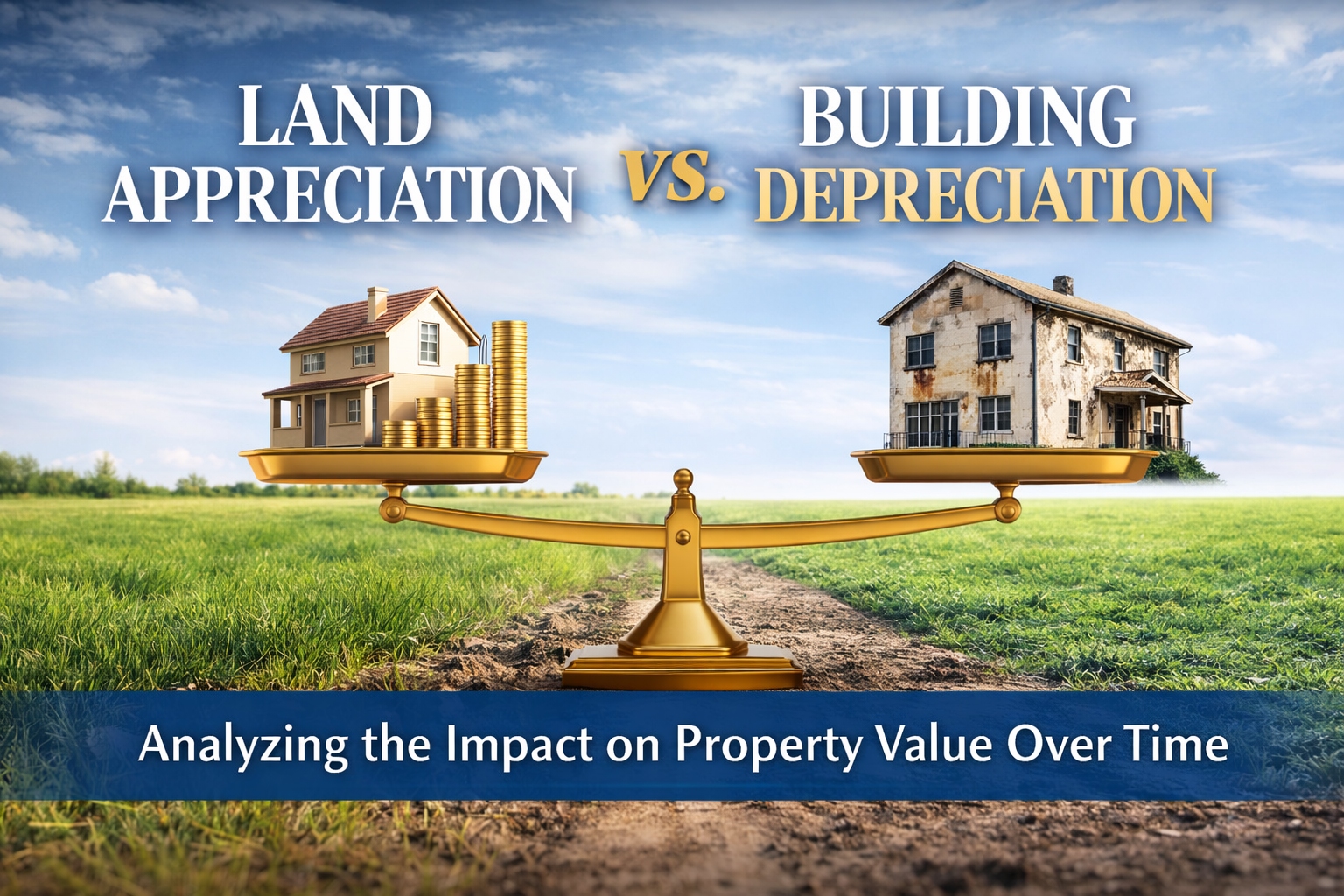
Land Appreciation vs Building Depreciation: Understanding the True Value of Developed Property Over Time
One of the most misunderstood concepts in real estate valuation is the simultaneous appreciation of land and depreciation of buildings. While land is generally finite and appreciates over time, buildings are physical assets subject to wear, functional obsolescence, and design aging. The interaction of these two forces determines the actual market value of a developed property.
This article explains how these forces work together, illustrates their combined effect over time using a numerical example, and clarifies the difference between market value and accounting depreciation commonly applied to buildings.
The Core Principle in Property Valuation
A developed property is not a single asset. It is a composite of two distinct components:
Land – a non-depreciating asset that typically appreciates due to scarcity, infrastructure growth, zoning, and demand.
Building (Improvements) – a depreciating asset whose value declines due to physical deterioration, functional obsolescence, and changing market preferences.
Market value = Land value (appreciating) + Building value (depreciating)
The key question is not whether a building depreciates—it does—but whether land appreciation outpaces building depreciation, and by how much.
Assumptions for the Illustration
To demonstrate the balancing effect, we assume the following realistic but simplified scenario:
Property type: Detached residential house in an established urban suburb
Valuation basis: Market value (not book value)
Initial valuation date: January 2021
Initial land value: KES 20,000,000
Initial building value: KES 15,000,000
Total property value (2021): KES 35,000,000
Assumed annual rates:
Land appreciation: 8% per annum (moderate urban growth)
Building depreciation: 2.5% per annum (market-based, not accounting)
Market Value Movement Over Time (2021–2026)
Illustrative Property Value Breakdown
| Year (January) | Land Value (KES) | Building Value (KES) | Total Market Value (KES) |
|---|---|---|---|
| 2021 | 20,000,000 | 15,000,000 | 35,000,000 |
| 2022 | 21,600,000 | 14,625,000 | 36,225,000 |
| 2023 | 23,328,000 | 14,259,000 | 37,587,000 |
| 2024 | 25,194,240 | 13,902,525 | 39,096,765 |
| 2025 | 27,209,779 | 13,554,962 | 40,764,741 |
| 2026 | 29,386,561 | 13,216,088 | 42,602,649 |
What This Table Demonstrates
1. The Building Loses Value Every Year
The building depreciates steadily, losing approximately KES 1.78 million in market value over five years.
This decline reflects:
Physical wear and tear
Aging finishes and fittings
Design becoming less competitive relative to new developments
Importantly, this is economic depreciation, not accounting depreciation.
2. Land Appreciation More Than Compensates
Over the same period, land value increases by approximately KES 9.39 million, driven by:
Urban growth
Infrastructure expansion
Increased demand and limited supply
Improved neighbourhood profile
3. Net Effect: Overall Property Value Increases
Despite the building depreciating, the total property value rises by over KES 7.6 million, a gain of roughly 21.7% over five years.
This is why, in strong urban locations, well-located older properties often appreciate despite aging structures.
Extending the Logic to a 10-Year Holding Period
Over a longer horizon (10–15 years), three outcomes typically emerge:
Land dominates value – land may represent 70–85% of total value.
Building becomes secondary – often contributing marginal value.
Redevelopment potential increases – highest and best use shifts from occupation to redevelopment.
This explains why older houses in prime locations are frequently sold “as land value,” even though the buildings remain usable.
Market Depreciation vs Accounting Depreciation
A critical distinction must be made between valuation depreciation and accounting depreciation.
Accounting Depreciation of Buildings (Book Value)
From an accounting perspective, buildings are treated as depreciable fixed assets, typically using:
Straight-line depreciation
Over 25–50 years, depending on policy and tax regulations
Example:
Building cost: KES 15,000,000
Useful life: 40 years
Annual depreciation: KES 375,000
After 5 years:
Accumulated depreciation: KES 1,875,000
Book value: KES 13,125,000
Key Characteristics:
Used for financial reporting and tax computation
Does not reflect market demand or location
Continues even if market value is rising
Why Accounting Depreciation ≠ Market Value
| Aspect | Accounting Depreciation | Market Depreciation |
|---|---|---|
| Purpose | Financial reporting | Valuation & pricing |
| Basis | Cost & useful life | Demand, utility, condition |
| Reflects location value | ❌ No | ✅ Yes |
| Can show loss while value rises | ✅ Yes | ❌ No |
A property can be fully depreciated in books yet sell at a premium due to land value.
Implications for Property Owners and Investors
1. Do Not Rely on Book Value to Assess Wealth
Book value understates property wealth in appreciating locations. Market valuation should always be used for:
Investment decisions
Financing
Sale or restructuring
Portfolio analysis
2. Land-Heavy Properties Offer Stronger Long-Term Security
Properties where land forms a higher proportion of value:
Are more resilient to building obsolescence
Offer redevelopment flexibility
Preserve capital better over time
3. Maintenance Slows Market Depreciation
While buildings depreciate, proper maintenance, renovations, and upgrades can:
Reduce the effective depreciation rate
Extend economic life
Improve rental and resale performance
4. Depreciation Is Not a Loss Until You Sell
Market depreciation of a building component is not a realised loss unless:
The property is sold below acquisition cost
Or redevelopment requires demolition
Strategic Insight for Developers and Valuers
For professional valuers, the interaction between land and buildings is central to:
Highest and best use analysis
Residual land valuation
Redevelopment feasibility studies
For developers, rising land value often signals the optimal timing for redevelopment, even when buildings remain structurally sound.
The apparent contradiction between building depreciation and property appreciation is resolved once land and improvements are viewed as separate economic assets. Over time, land appreciation typically outweighs building depreciation, particularly in established urban markets.
Understanding this balance is essential for:
Accurate valuation
Sound investment decisions
Proper interpretation of financial statements
Long-term real estate strategy
In real estate, the building ages—but land remembers the future.

Last updated:
