

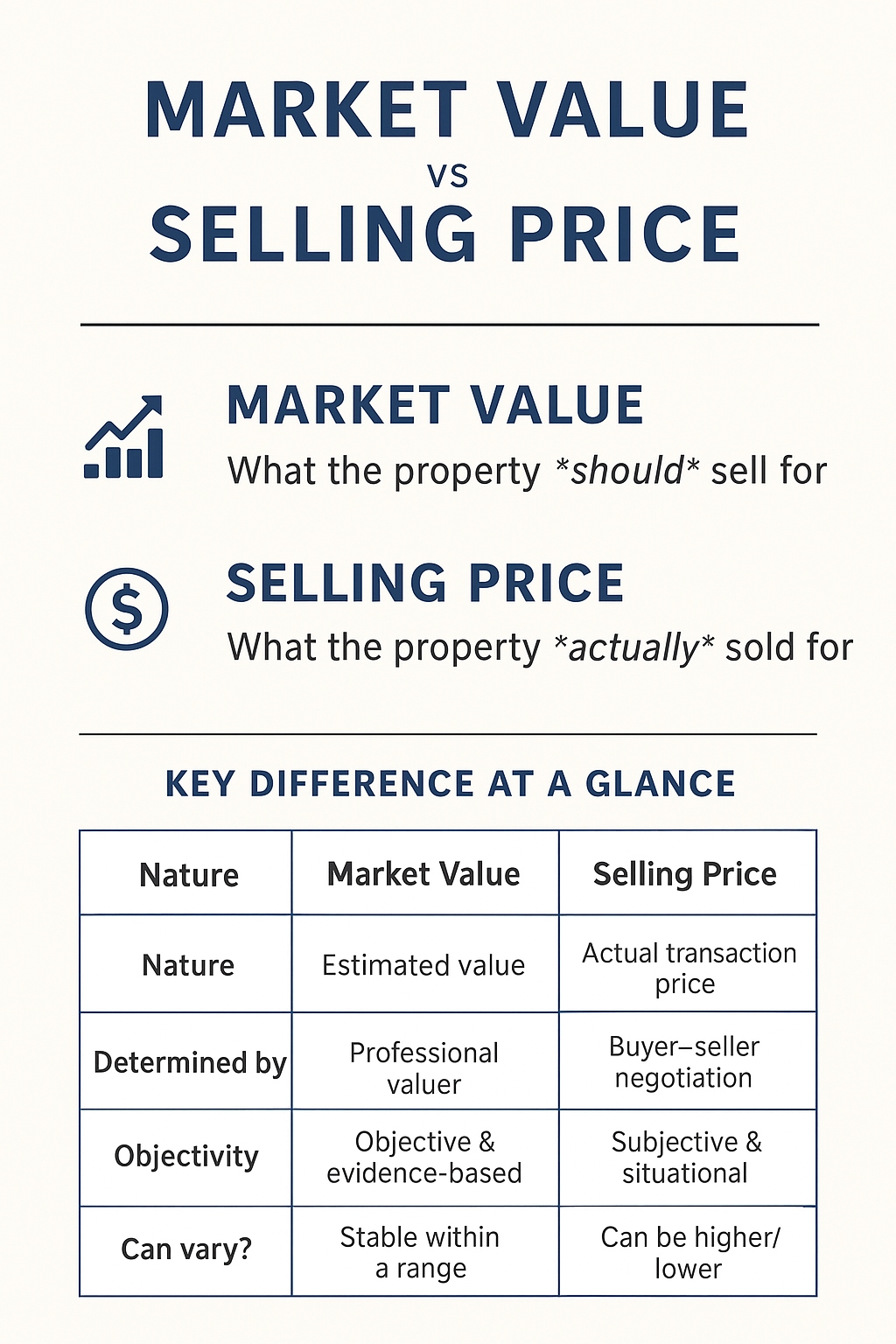
Market Value vs Selling Price: Key Differences and How Insurance, Forced Sale, and Mortgage Values Fit In.
In real estate, every property carries multiple values—each calculated for a different purpose and used by different stakeholders. Whether you are a buyer, seller, investor, valuer, or developer, understanding how market value, selling price, insurance value, forced sale value, and mortgage value differ is essential for making informed decisions.
These terms may appear similar, but each plays a distinct role in the valuation and transaction cycle of a property. In this guide, we break down what each means, how they are determined, when they are used, and why they matter—especially in the context of modern real estate markets like Kenya, East Africa, and global property hotspots.
What Is Market Value?
Market Value is the estimated amount a property should sell for in an open and competitive market, assuming:
The buyer and seller act knowledgeably and prudently
Both parties are motivated but not desperate
The property has been properly marketed
The transaction happens in a reasonable time
Market value is the most widely recognized valuation metric and is typically used for:
Buying and selling decisions
Financial reporting
Investment analysis
Taxation and stamp duty
Development feasibility
How Market Value Is Determined
Professional valuers assess market value using recognized approaches:
Sales Comparison Approach – compares similar properties recently sold
Income Approach – evaluates the property based on rental income(
- Investment Method – used for commercial income-generating properties)
Cost Approach – considers replacement cost minus depreciation
Why Market Value Matters
Market value provides an unbiased benchmark of what the property should be worth under typical conditions. It protects both buyers and sellers and brings clarity to negotiations, lending, risk assessment, and investment planning.
What Is Selling Price?
The Selling Price is the actual price at which a property is sold.
This amount can be:
Higher than market value
Equal to market value
Lower than market value
Unlike market value, which is an estimate, selling price is a real transaction figure, influenced by many factors outside valuation principles.
What Influences Selling Price?
Urgency of the seller (financial pressure, relocation deadline)
Buyer’s negotiation power
Market competition (bidding wars)
Property condition and presentation
Emotional attachment or unique features
Misinformation or lack of professional guidance
Market Value vs Selling Price: Key Differences
| Feature | Market Value | Selling Price |
|---|---|---|
| Nature | Estimated value | Actual transaction price |
| Based on | Objective valuation principles | Real-world negotiation & motivation |
| Determined by | Professional valuer | Buyer & seller |
| Can fluctuate? | Stable estimate | Highly variable |
| Use | Planning, investment, lending | Final contractual price |
In simple terms:
Market value is what the property should sell for; selling price is what it actually sells for.
What Is Insurance Value?
Insurance Value—also called Reinstatement or Replacement Value—is the cost required to rebuild or replace the property if it were destroyed, usually due to fire, floods, or other insured risks.
It does not include:
Land value
External infrastructure
Improvements not insured
Why Insurance Value Is Important
Prevents underinsurance, which can lead to partial claim settlement
Ensures accurate insurance premiums
Helps property owners manage risk
Required by mortgage lenders and commercial landlords
How Insurance Value Is Calculated
Insurance value considers:
Current construction costs
Professional fees (architects, engineers, quantity surveyors)
Demolition and debris removal
Compliance with local building regulations
- Adjustments for inflation
Insurance companies rely on valuers to provide accurate figures because replacement costs often rise faster than market values, especially in inflationary environments.
What Is Forced Sale Value (Reserved Value)?
Forced Sale Value (FSV)—also known as the Reserved Value—is the estimated amount a property would fetch if sold within a very short time frame, typically under pressure or compulsion.
Examples include:
Bank repossession
Auction
Distress sale due to financial difficulty
Legal orders
Forced Sale Value Is Usually Lower
Because the seller has little control, FSV is typically reserved at maximum of 25% below market value, depending on market conditions.
Why Forced Sale Value Matters
FSV is used in:
Banking and risk assessment
Auction sales
Debt recovery
Liquidation and insolvency proceedings
Collateral risk monitoring
When valuers determine the forced sale value, they account for:
Reduced marketing exposure
Limited buyer pool
Urgency of sale
Likelihood of deep discounts
What Is Mortgage Value?
Mortgage Value is the value that lenders (banks or financial institutions) use when deciding how much money to lend against a property.
It is often conservative and generally lower than market value, intended to minimize lending risk.
How Mortgage Value Is Determined
Banks consider:
Market value
Borrower’s risk profile
Economic conditions
Property location and liquidity
Long-term value stability
This value directly affects:
Loan amount
Loan-to-Value ratio (LTV)
Mortgage approval
Interest risk assessment
For example:
If a property’s market value is KES 10 million, the bank may assign a mortgage value of KES 8.5 million and lend up to 70–80% of that figure.
Market Value vs Insurance Value vs Forced Sale Value vs Mortgage Value
Here is a quick comparison of the four property values:
| Type of Value | Meaning | Usually Higher or Lower? | Common Use |
|---|---|---|---|
| Market Value | Expected price in open market | Baseline (neutral) | Buying, selling, reporting |
| Selling Price | Actual agreed sale price | Can be higher or lower | Final transaction |
| Insurance Value | Cost of rebuilding property | Often higher than market value but excludes value of land | Insurance cover & claims |
| Forced Sale Value | Distress or auction sale value | Lower than market value | Debt recovery, repossession |
| Mortgage Value | Bank-secured lending value | Slightly lower than market value | Loan approvals & LTV |
Why These Values Matter in Real Estate
Understanding these value types empowers buyers, investors, developers, and lenders to:
Make informed financial decisions
Negotiate from a position of knowledge
Avoid overpaying or underinsuring
Assess risk accurately
Evaluate investment potential
Understand lender requirements
Each Value Serves a Different Purpose
Real estate valuation is not one-size-fits-all.
A property may simultaneously have:
A market value (what it should sell for)
A selling price (what it actually sells for)
An insurance value (what it costs to rebuild)
A forced sale value (what it would fetch under pressure)
A mortgage value (what banks use for lending)
Understanding the difference ensures transparency, protects property owners, and helps investors and stakeholders make smarter decisions.
The Role of a Property Valuer in Determining These Values
A professional property valuer is the cornerstone of accurate, unbiased, and compliant property assessments. Their role ensures that all stakeholders—buyers, sellers, insurers, banks, courts, investors—operate with reliable, evidence-based information.
Here’s how a valuer contributes to each type of value:
i. Determining Market Value
Valuers assess Market Value using:
Comparable sales analysis
Cost approach
Income or investment approach
Market data and economic trends
Their independent judgment provides a realistic estimate of what a property is worth in a fair, open market.
ii. Differentiating Market Value from Selling Price
Because the Selling Price can be distorted by negotiations and emotional decisions, valuers:
Offer an objective benchmark
Help set a realistic asking price
Protect buyers from over-paying
Support sellers in pricing strategy
Guide agents on valuation-backed listing prices
This ensures transparency and fairness in transactions.
iii. Establishing Insurance Value
Valuers calculate rebuilding costs by assessing:
Construction materials
Structural systems
Professional fees
Mechanical and electrical installations
Building regulations
Their assessment prevents under-insurance and over-insurance, protecting property owners financially.
iv. Assessing Forced Sale Value
When properties must be sold under pressure, valuers:
Determine realistic auction values
Factor in reduced exposure time
Analyze market liquidity
Evaluate distress-rating adjustments
Banks and courts rely heavily on these assessments for recovery actions.
v. Establishing Mortgage Value
Valuers help banks assess:
Long-term property worth
Lending risk
Market stability
Collateral strength
Their reports guide the underwriting of loans and determine loan limits.
vi. Providing Professional Advisory
Beyond valuations, valuers also:
Offer investment advice
Conduct feasibility studies
Support asset management
Provide valuation for financial reporting
Assist in dispute resolution and compensation cases
They bring technical, legal, and financial expertise that helps clients make strategic decisions.
vii. Adhering to Standards
Professional valuers follow strict global and local standards including:
International Valuation Standards (IVS)
RICS Red Book
Kenya Valuation Standards (KVS)
The Valuers Act
Institutional and regulatory guidelines
This ensures that all valuation reports are credible, defensible, and compliant.

Last updated:
